Motivational Interviewing for Addiction Treatment in Kansas
Holland Pathways’ Multidisciplinary Recovery Team
13 min read
Written by
Written and medically reviewed by the multidisciplinary team at Holland Pathways, including licensed therapists, addiction specialists, and medical professionals.
Recovery starts with one conversation.
Reach out to Holland Pathways and talk to someone who understands.
Motivational interviewing is a person-centered counseling style built for ambivalence, treating the 50/50 feeling as a normal starting point rather than a barrier to Kansas treatment.12
Research shows MI reduces substance use compared with no treatment, with the strongest effect right after sessions, though it performs similarly to other active therapies like CBT.2,1
An MI-shaped intake improves early retention through 28 days, meaning the tone of that first Kansas phone call often determines whether ambivalent callers return.7
Kansans who are unsure can call a program like Holland Pathways in Wichita to talk without commitment, at their own pace, across detox through aftercare.
When You’re Not Sure You Want to Quit Yet
You’ve probably been here before. Maybe last night, maybe last week. You told yourself this would be the last time, or you told yourself nothing was wrong, or you told yourself both in the same hour. And now you’re reading an article about addiction treatment in Kansas, which means some part of you is looking around for a door.
Here’s what a lot of pages like this one won’t say out loud: you don’t have to be sure. You don’t have to have hit some invisible bottom. You don’t have to walk in with a plan, a speech, or a clean answer to the question, Do you want to stop? Being unsure doesn’t disqualify you from getting help. It’s actually the exact starting point that motivational interviewing was designed for.
Motivational interviewing (MI) is a person-centered counseling style built around the reality that most people who use substances are ambivalent — pulled in two directions at once. A good MI conversation doesn’t try to argue you out of that. It sits down next to it. No lectures. No confrontation. No one telling you what you already know.12
This piece is written for the Kansan who’s still 50/50. You’ll see what MI actually sounds like, what the research honestly says it can and can’t do, and how it fits into the way Holland Pathways in Wichita talks about meeting clients where they’re at. Reading this counts as a step.
What Motivational Interviewing Actually Is (and Isn’t)
A Conversation Style Built for Ambivalence
Motivational interviewing is a counseling style, not a program you sign up for or a script a therapist reads at you. At its core, it’s a way of talking with someone about change that assumes you’re already thinking about it — even if you haven’t said so out loud, even if you’d argue the opposite if pushed.12
That’s the ambivalence part. Being pulled in two directions is not a character flaw or a sign you’re not ready. It’s the normal state of most people who use substances. You want relief, and you want out. You want the drink, and you want your evenings back. Both things can be true at the same time, and MI treats that as the honest starting point rather than a problem to fix.3
What MI isn’t: it isn’t a confrontation. It isn’t a debate. It isn’t a counselor arguing that your life is worse than you think or listing consequences you can already recite in your sleep. The CDC describes it plainly as a collaborative conversation designed to strengthen your own motivation and willingness to consider treatment. The person across from you is trying to hear you, not corner you. That difference is felt within the first few minutes.13
The PACE Spirit: Partnership, Acceptance, Compassion, Evocation
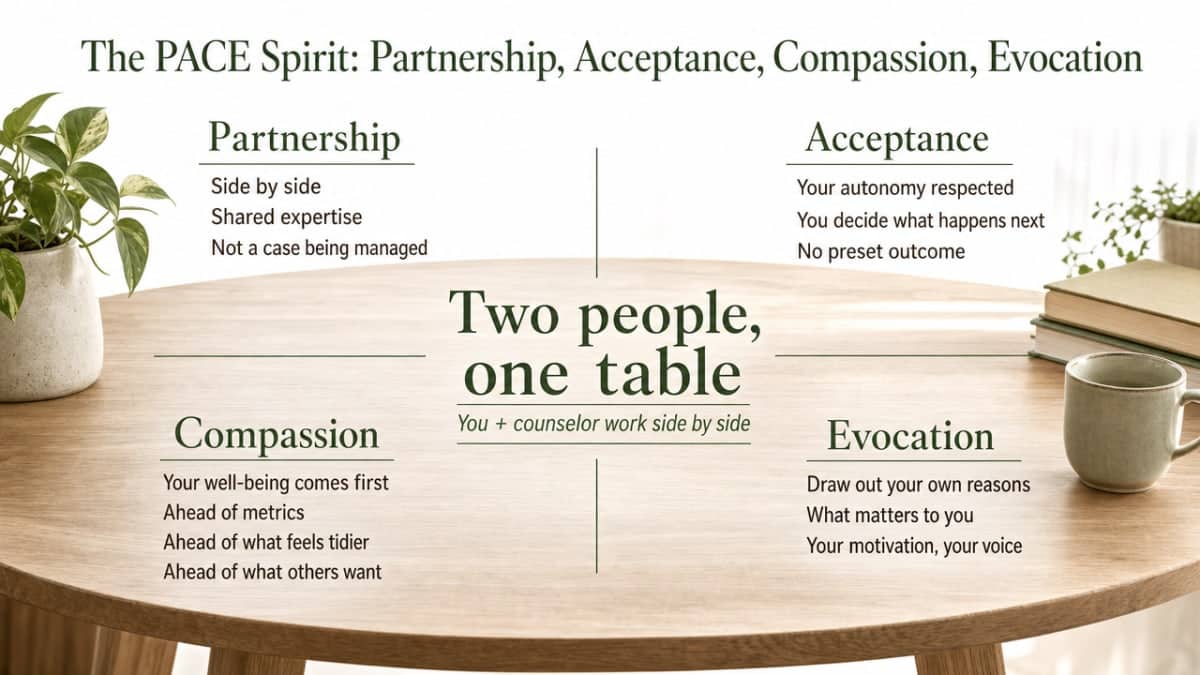
MI has a spirit before it has any techniques, and the spirit is the part that matters most when you’re the person on the other side of the table. SAMHSA describes it as PACE: partnership, acceptance, compassion, and evocation.12
Principle
Description
Partnership
means you and the counselor are working side by side. You’re not a case being managed. You’re the expert on your own life, and they bring what they know about change. Two people, one table.
Acceptance
means your autonomy is respected. You get to decide what happens next. A good MI clinician doesn’t quietly steer you toward a preset outcome; they take seriously that you might choose something different than what they’d choose for you.
Compassion
means your well-being comes first — ahead of program metrics, ahead of what would be tidier, ahead of what a family member wants you to agree to today.
Evocation
is the quietly radical one. Instead of pouring information into you, an MI counselor draws reasons for change out of you. Your reasons. Not their reasons dressed up in your language. This is why MI sessions often feel less like being taught and more like being listened to on purpose — sometimes for the first time in a long time.
What an MI Conversation Sounds Like in the Room
The easiest way to demystify motivational interviewing is to hear it. SAMHSA’s TIP 35 lays out four processes that shape a good MI conversation: engaging, focusing, evoking, and planning . They’re not steps you march through in order — a counselor may loop back to engaging in the middle of planning if you go quiet, or slow down and re-focus if a new worry surfaces. The shape is closer to a spiral than a checklist.3
Engaging is the first stretch. It sounds like, “What brought you in today?” or “Before we talk about anything else, I’d like to hear how you’re doing this week.” No forms shoved across the table. No diagnosis speech. The counselor is trying to build enough trust that you can be honest with them, and honest with yourself in front of them.
Focusing is when the two of you agree — together — on what’s worth talking about. Maybe it’s the drinking. Maybe it’s the panic attacks that started before the drinking. Maybe it’s your relationship with your kid. You get a say in the agenda, which is a small thing that turns out to be a big thing 3.
Evoking is the heart of MI. This is where the counselor asks questions that draw your own reasons for change into the open. “What would you want to be different six months from now?”“What’s the part of this that’s hardest to sit with?”“You said you were tired — tell me more about that kind of tired.” You may hear a reflection right after, something like, “So you’re worn out, and part of you is starting to wonder if there’s another way to live.” Reflections are not parroting. They’re a way of testing whether the counselor is actually tracking what you meant, and giving you a chance to hear your own words back.3
Planning only shows up when it’s earned. If you’re not ready, a good MI counselor doesn’t force it. If you are, planning sounds like, “What feels like a reasonable next step for you this week?” — not a discharge packet and a treatment start date you didn’t agree to.
Notice what isn’t there: no warnings, no ultimatums, no pop quiz about consequences. Just a conversation that keeps making room for you to say the true thing.
Why MI Fits People Who’ve Been Lectured Before
If you’ve been in and out of conversations about your drinking or using for years, you know the script by heart. Someone sits you down. They list what you’re doing to yourself, to them, to the people who love you. You nod, or you argue, or you go quiet. Nothing changes, because the part of you that already knew all of that isn’t the part that needs convincing.
Motivational interviewing skips that script on purpose. The counselor isn’t there to tell you what you already know. They’re not stacking evidence against you or waiting for you to break. SAMHSA’s guidance is direct about this: MI clinicians deliberately avoid pushing toward action before you’ve had room to sit with your own reasons. Advice that lands before you’re ready tends to bounce off, and a good MI clinician knows it.3
What that means in practice: when you say something ambivalent — “I know it’s bad, but it’s the only thing that shuts my head off at night” — you’re not going to get a rebuttal. You’ll get a reflection. Something like, “So it’s costing you, and it’s also the tool you have right now.” Both parts, held at once. Nobody trying to win.
For a lot of Kansans, that’s the first conversation about substance use that doesn’t feel like a fight. Holland Pathways talks about meeting clients where they’re at, and this is what that phrase actually looks like when the door closes and it’s just you and a counselor in a room.
Says About MI
What the Research Actually
Here’s the honest version, because you deserve one. Motivational interviewing has decades of studies behind it, and the picture is more useful than either “miracle cure” or “just another therapy.” Both of those framings would waste your time.
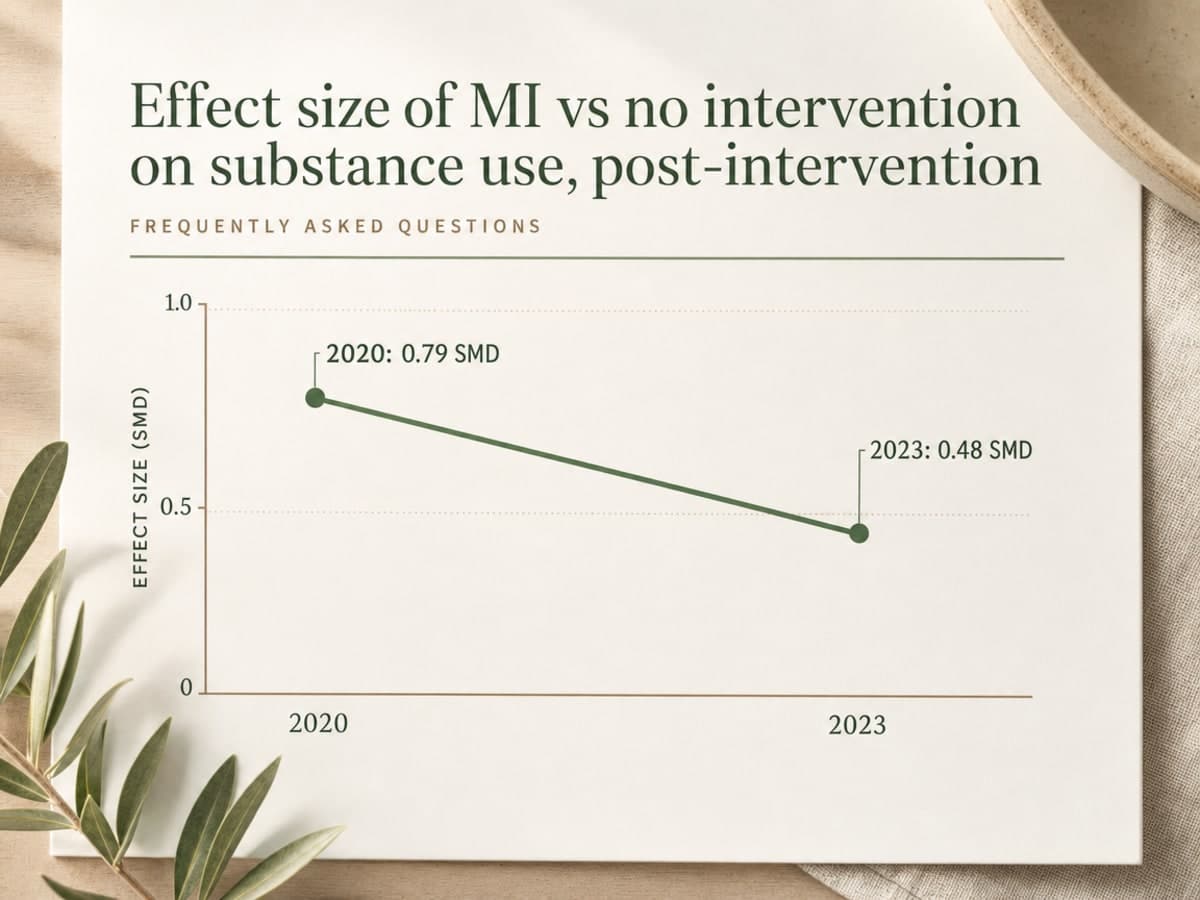
The clearest finding: MI beats doing nothing. A large meta-analysis of randomized trials in people with substance use problems found the strongest effect right after the intervention, with a standardized mean difference of 0.79 (95% CI 0.48–1.09) compared with no-treatment controls. In plain terms, people who got MI cut back on their substance use meaningfully more than people who got no help at all. That effect got smaller at short- and medium-term follow-ups, which is the pattern you’d expect from any single course of counseling — the further out you look, the more life crowds back in. This is why MI usually shows up as one piece of a longer plan, not the whole plan.2
The 2023 review that synthesized more recent trials tells the same story with cautious language: MI probably reduces substance use compared with no intervention through short follow-up, and probably produces slight reductions compared with basic assessment and feedback over medium and long term. BMJ Mental Health’s summary lands in the same place — MI is more effective than nothing for people with substance dependency.1,6
Why does that matter to you? Because it means the choice in front of you isn’t MI or something better. It’s MI or nothing, at least for this week. And the research is pretty clear on that comparison. There’s also encouraging evidence in specific situations — group MI reduced binge drinking in college students at one- and three-month follow-up (RR ≈ 0.74), and adolescents receiving MI cut alcohol use more than those in an educational control. Different formats, different ages, similar direction.8,9
What the evidence doesn’t promise: it won’t hand you certainty about quitting. What it does say is that a conversation grounded in MI is more likely to move you than staying where you are alone.
Source: Motivational interviewing for substance abuse – PMC – NIH
Why MI Helps Ambivalent People Actually Stay in Treatment
Here’s a finding that matters more than most headline effect sizes: in a community outpatient trial, people who received a motivational interviewing intake stayed engaged longer than people who got a standard intake. Retention through 28-day follow-up was significantly better in the MI group, even though later substance use outcomes didn’t differ from the comparison. Read that carefully. It says the first conversation changes whether you come back.7
That’s a big deal when you’re ambivalent. Most people don’t drop out of treatment because they decided they don’t need it. They drop out because the first contact felt cold, or pushy, or like a form was more important than they were. If the opening conversation is MI-shaped — you’re heard, you’re not cornered, your reasons get to be your reasons — you’re more likely to show up for the next appointment. And the next.
That’s why the shape of the first call is not a small thing. It’s the thing. You don’t have to walk in decided. You have to walk in — or dial in — once. MI is built to make that first step survivable for someone who isn’t sure they want to take it.
Holland Pathways’ philosophy of meeting clients where they’re at plugs into this directly. If the front door of a 64-bed Wichita campus feels like a lecture, ambivalent people don’t come back. If it feels like a conversation, some of them do. That’s the whole difference between a plan you follow through on and a call you never return.
MI for Veterans, Trauma, and Co-Occurring Conditions
If you’re a veteran, or if trauma is part of your story, or if there’s a mood disorder underneath the drinking or using, the last thing you need is a counselor who confronts. Confrontation lands as threat when your nervous system has already spent years scanning for one. That’s a real clinical problem, and it’s one of the reasons motivational interviewing exists.
MI’s whole posture — partnership, acceptance, compassion, and drawing your reasons out instead of pushing information in — is built to protect autonomy. For someone with PTSD, autonomy isn’t a nice-to-have. It’s the thing that determines whether you can stay in the room. When a counselor asks permission before shifting topics, reflects what you’ve said instead of interpreting it, and doesn’t push toward action before you’ve had time to sit with your own words, they’re doing more than being polite. They’re keeping the conversation safe enough to continue.3,12
Co-occurring depression, anxiety, or bipolar disorder complicates ambivalence. On a low day, you may want to quit and mean it. On a numb day, the whole idea of change can feel impossible. MI doesn’t punish that variability. A skilled clinician meets whichever version of you showed up that hour and works from there.
At Holland Pathways in Wichita, veterans and dual diagnosis clients make up a meaningful share of who walks through the door. Trauma-informed care and MI share the same core move: you set the pace, and the clinician follows without losing the thread.
Where MI Fits Inside a Kansas Continuum of Care
The Front Door: Intake, Assessment, and First Calls
The front door of treatment is usually a phone call, and phone calls are where most ambivalent people quit before they’ve started. That’s why the first conversation matters more than a brochure ever will.
An MI-informed intake doesn’t open with a clipboard. It opens with a question you actually get to answer in your own words — something closer to “What’s going on for you right now?” than “Insurance carrier and date of birth?” The paperwork still gets done. It just isn’t the point. SAMHSA’s guidance is explicit that MI opens with open questions, affirmations, reflective listening, and summarizing, and holds off on pushing toward action until readiness has been explored.3
What that means for you: if you call a Kansas program that runs its front door this way, you can say “I don’t know if I want to do this” and the person on the other end won’t panic, upsell, or hang up. They’ll ask what would make a next step feel possible. That’s the assessment. It’s also the first real piece of treatment.
From Detox Through Aftercare at Holland Pathways
MI isn’t a service you graduate from. It’s a way of talking that follows you through every level of care, which matters when a Kansas continuum can stretch across weeks or months.
At Holland Pathways in Wichita, the path runs from medically-monitored detox into 60-day residential treatment, then partial hospitalization, intensive outpatient, standard outpatient, and ongoing aftercare. Each of those stages is a different intensity — different hours, different setting, different people in the room — but the underlying posture doesn’t change. Partnership, acceptance, compassion, evocation. You are still the one making the calls about your own life; the clinicians are still trying to draw your reasons out rather than pour theirs in.12
That continuity is part of why the first conversation is worth having. Retention data from a community outpatient trial showed that an MI-shaped intake improved early retention through 28 days. Staying engaged is what lets the rest of a continuum actually happen — the group session next week, the check-in next month, the alumni call next year.7
For veterans and dual diagnosis clients, that steady posture matters twice. Trauma-informed care and MI share the same instinct: don’t push, don’t confront, don’t rush past what you’ve heard. Whether you’re on day two of detox or six months into aftercare, the conversation is still yours to shape.3
Source: Motivational interviewing for substance abuse – PMC – NIH
What a No-Pressure First Call Can Actually Look Like
You dial the number. Someone picks up. That’s the whole feat, and it’s a bigger one than most people give you credit for.
Here’s what a no-pressure first call sounds like when the person on the other end is trained in motivational interviewing. They don’t open with a sales pitch or a fifteen-minute intake grid. They ask something like, “What made today the day you called?” Then they listen. If you say you’re not sure you want treatment, that’s not a wrong answer — it’s the honest one, and it’s the one they were expecting.13
You can say the messy version. You can say you called and you don’t know why. You can say your sister told you to. You can say you’ve tried before and it didn’t stick. None of that ends the call. A good MI-informed clinician will reflect what they heard, ask what would make a next step feel possible, and leave the decision with you.3
At Holland Pathways in Wichita, that first conversation isn’t a commitment. It’s a chance to talk with someone who won’t push. If you’re 50/50, you’re exactly who this call is for. One call. Your pace.
Ready to Start Your Recovery Conversation Today?
Connect now to discuss a treatment plan that meets you exactly where you are.
Do I have to be ready to quit before I try motivational interviewing?
No. MI was built specifically for people who aren’t sure yet. It’s designed to help you work through the pulled-in-two-directions feeling instead of skipping past it. Showing up unsure isn’t a wrong answer — it’s the starting point the whole approach assumes. You get to explore your own reasons at your own pace, and no one asks you to commit to anything you haven’t chosen.12
Will a counselor pressure me or tell me what to do?
Not in a real MI conversation. The counselor’s job is to draw your reasons out, not push theirs in. You’ll hear open questions and reflections of what you said, not lectures or ultimatums. SAMHSA’s guidance is explicit that MI clinicians hold off on pushing toward action until readiness has been explored. Your autonomy stays intact. You decide what happens next — including whether there is a next.3,12
Does motivational interviewing actually work for addiction?
The honest answer is yes, with limits. MI reduces substance use compared with no treatment, especially right after the sessions. Against other active therapies like solid CBT or well-run treatment-as-usual, MI performs about the same rather than clearly better. So it’s not a miracle, and it’s not a gimmick. It’s a real, evidence-based way to start — and starting is the part most people get stuck on.1,2,6
Is motivational interviewing safe if I’ve been through trauma or have PTSD?
MI’s posture fits trauma-informed care well. Partnership, acceptance, compassion, and drawing out your own reasons all protect your autonomy instead of overriding it. A skilled clinician asks permission before shifting topics, reflects what you said instead of interpreting it, and doesn’t push past what you’re ready to sit with. That’s the same instinct trauma-informed work runs on. You set the pace; the conversation follows.3,12
What happens on a first call if I’m still 50/50 about change?
An MI-informed first call opens with a real question, not a sales pitch. Something like, “What made today the day you called?”. You can say you’re unsure. You can say you don’t know why you dialed. A trained clinician will reflect what they heard and ask what would make a next step feel possible. No commitment. No script. The call ends when you say it does.3,13
How does MI fit with detox, residential, and outpatient care at Holland Pathways?
MI isn’t a separate service — it’s the posture the clinicians carry through every stage. At Holland Pathways in Wichita, the continuum runs from medically-monitored detox into 60-day residential, partial hospitalization, intensive outpatient, standard outpatient, and aftercare. The intensity changes; the meeting-you-where-you-at approach doesn’t. That consistency matters, because an MI-shaped intake improves early retention through 28 days— which is what makes the rest possible.7,12
Motivational interviewing to improve treatment engagement and outcome in individuals seeking treatment for substance abuse: a randomized controlled trial. https://pmc.ncbi.nlm.nih.gov/articles/PMC2386852/
Explore comprehensive 60-day residential addiction treatment in Wichita, KS, focusing on trauma therapy, medication, and relapse prevention for lasting recov...