
Key Takeaways
- Fentanyl stores in fatty tissue and releases for days after last use, making the old ‘wait for withdrawal, then dose buprenorphine’ rulebook unreliable without medical supervision.
- Starting buprenorphine within 24 hours of fentanyl use significantly raises the odds of severe precipitated withdrawal, which is why induction timing belongs in a monitored setting 11.
- Choosing between buprenorphine, methadone, and naltrexone is a shared clinical decision based on tolerance, setting, and history — not a ranking of which drug is strongest 1.
- The handoff from detox into 30–60 days of residential care, plus naloxone and trained family at home, is where recovery actually holds 2, 5.
Why fentanyl changed what starting treatment looks like
If you’re reading this at 2 a.m., or between doses, or from a hospital chair next to someone you love, you already know something important: fentanyl doesn’t behave like other opioids. And starting treatment for it doesn’t either. That’s not your fault, and it’s not a reason to wait longer. It’s the reason to get somewhere with medical supervision.
Here’s what changed. Fentanyl is far more potent than heroin or prescription painkillers, and it stores in fatty tissue in ways that older opioids don’t. That means it can keep releasing into your bloodstream for days after your last use, even when you feel like you’re already deep in withdrawal. The old clinical rulebook — wait until withdrawal starts, then begin buprenorphine — was written for a drug supply that no longer exists in most of the country. Federal surveillance still identifies fentanyl as the dominant driver of U.S. overdose deaths, which is why treatment access and rapid entry into care have become a public health priority 6.
The good news, and this matters: medications work. Buprenorphine, methadone, and naltrexone are the FDA-approved options for opioid use disorder, and combining them with counseling gives you what SAMHSA calls a whole-patient approach 1. NIDA is direct about it — medications are the standard treatment for fentanyl addiction, not an optional add-on 7.
What’s different now is the first 72 hours. Getting those hours right — the timing of your first buprenorphine dose, the setting you’re in, who’s watching your symptoms — shapes whether your treatment feels like relief or like being thrown back into the worst withdrawal of your life. That’s the specific problem the next section unpacks.
The buprenorphine induction problem, in plain language
Here’s the honest version of what your care team is thinking about when you walk in. Buprenorphine is a partial opioid agonist — it grabs the same brain receptors that fentanyl grabs, but it holds on tighter and activates them less. If you still have a lot of fentanyl sitting on those receptors when your first dose hits, buprenorphine can shove it off and drop you into what’s called precipitated withdrawal. That’s a sudden, severe withdrawal that comes on within an hour of the dose and can be worse than anything you’ve felt going cold turkey.
For decades, the standard rule — the one written into SAMHSA’s TIP 63 — was straightforward: wait until you’re already in mild-to-moderate withdrawal, then give the first dose 3. That rule worked well when the street supply was heroin or oxycodone. Those drugs cleared quickly, so by the time you felt sick, your receptors were empty enough for buprenorphine to slot in smoothly.
Fentanyl broke that logic. Because fentanyl stores in fatty tissue and keeps leaching back into your bloodstream, you can look and feel like you’re in full withdrawal while your receptors are still partly occupied. A peer-reviewed study of people who use fentanyl found that the odds of severe precipitated withdrawal were significantly elevated when buprenorphine was taken within 24 hours of last fentanyl use, and still elevated in the 24-to-48-hour window afterward 11. That’s the study that changed how a lot of clinicians think about timing.
What that means for you, practically: the fear you’ve probably heard about — that starting the medication will make you sicker instead of better — is a real clinical concern, not something you invented. It’s also a solvable one. In a supervised medical setting, a clinician can watch your withdrawal score, ask about your last use in specific hours, and adjust when and how they start you. Some people wait longer. Some start with tiny fractional doses over several days so buprenorphine builds up gradually without displacing anything. Some go the opposite direction with a higher first dose under close observation. None of those decisions should be made alone in a bathroom with a strip of medication and a stopwatch.
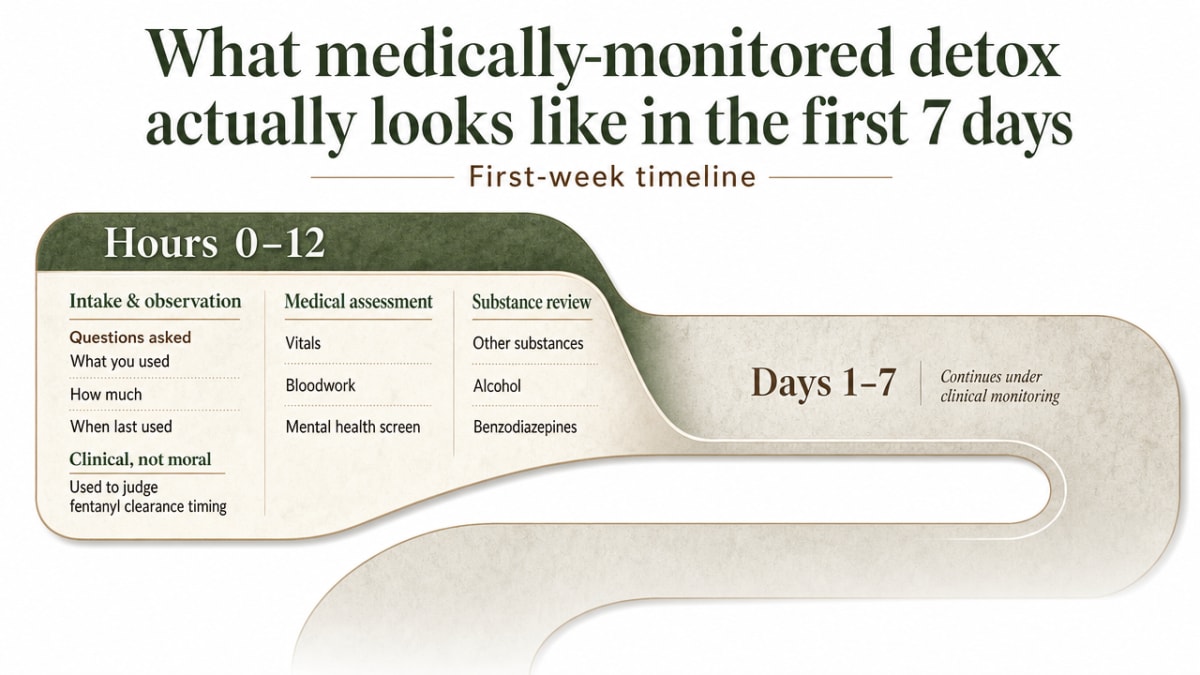
What medically-monitored detox actually looks like in the first 7 days
You’ve probably imagined this week already, and whatever you’re picturing is likely worse than what actually happens. So here’s the real timeline, grounded in the federal induction guidance clinicians follow 3, 8. Not to promise you it will be easy — fentanyl withdrawal isn’t easy — but so you know what the shape of it looks like from the inside.
Hours 0 to 12: intake and observation. When you arrive, someone will ask you specific questions: what you used, how much, and — most importantly — when. That last-use time is not a moral question. It’s a clinical one. It tells the team where you are on the fentanyl clearance curve and how long they should wait before offering the first dose of buprenorphine. Expect vitals, bloodwork, a mental health screen, and questions about other substances (alcohol and benzodiazepines change the plan). You’ll be assigned a bed, and a nurse will start scoring your withdrawal symptoms using a standardized scale every few hours.
Hours 12 to 48: the hardest window. This is when most people feel the worst. Sweating, gooseflesh, muscle aches, restless legs, nausea, diarrhea, anxiety that feels like electricity under your skin. Your team can treat almost all of it with non-opioid comfort medications — clonidine for the autonomic symptoms, anti-nausea drugs, something for sleep, muscle relaxers, IV fluids if you can’t keep water down. TIP 63 directs clinicians to wait until you’re showing objective signs of withdrawal before starting buprenorphine, and to individualize dosing during hospitalization rather than applying a single formula 3. In practice, that often means someone is checking on you every two to four hours and adjusting the plan based on how your body is actually responding.
Day 2 to Day 4: the induction itself. Once your withdrawal score is high enough — and enough time has passed since your last fentanyl exposure — the team starts buprenorphine. Depending on your history, this might be a standard induction, a low-dose approach that builds up over several days, or a hospital-based higher-dose strategy. The SAMHSA prescribing tools clinicians rely on emphasize starting under observation and adjusting the next dose based on how you respond to the first 8. If precipitated withdrawal happens anyway (it sometimes does, even with careful timing), you’re in the right place for it — nurses can give additional buprenorphine and comfort medications to push through it, which is not something you want to attempt alone.
Day 4 to Day 7: stabilization and planning. By this point, most people are on a stable buprenorphine dose, sleeping in longer stretches, eating again, and starting to feel like a person instead of a symptom. This is when the clinical work shifts from managing your body to planning what happens next. You’ll meet with counselors, review your history, and — if the program is doing its job — begin the transition into residential care before your discharge date. Withdrawal management is the beginning. What you do in the weeks after is what actually holds.
None of this is glamorous. But every hour of it is designed around the specific fact that you’re being cared for, watched, and adjusted for. That’s the difference between a supervised week and a solo one.
The three FDA-approved medications and how a clinician picks
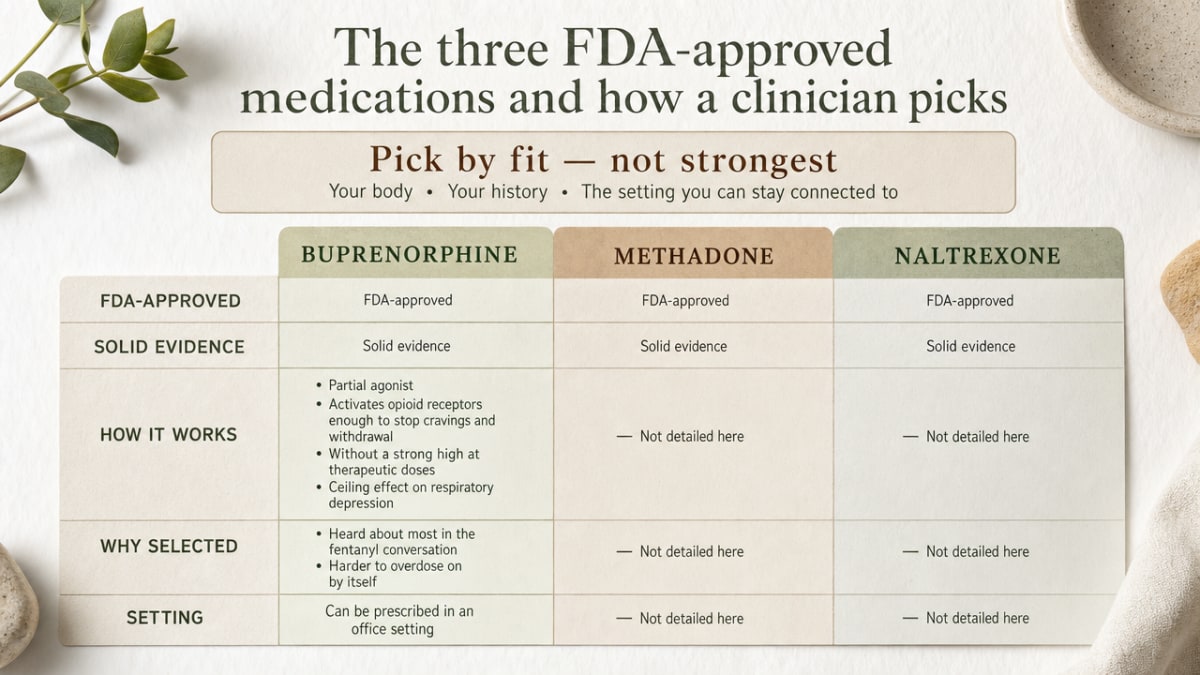
When you hear people talk about “medication for opioid use disorder,” they’re almost always talking about one of three drugs: buprenorphine, methadone, or naltrexone. All three are FDA-approved. All three have solid evidence behind them. And they work in very different ways, which is why the choice isn’t about which one is “strongest” — it’s about which one fits your body, your history, and the setting you can realistically stay connected to 1.
Buprenorphine is the one you’ll hear about most in the fentanyl conversation. It’s a partial agonist, which means it activates opioid receptors just enough to stop cravings and withdrawal without producing a strong high at therapeutic doses. It has a ceiling effect on respiratory depression, so it’s harder to overdose on by itself. Because it can be prescribed in an office setting and taken home as a daily film or tablet, it’s the most accessible option for most people. The 2026 systematic review of fentanyl-related opioid use disorder — which pulled together 180 studies — kept buprenorphine at the center of the treatment picture, while noting that induction strategies are still being refined for people with heavy fentanyl exposure 10.
Methadone is a full agonist. It fully activates the same receptors fentanyl does, but with a long, steady half-life that flattens the peaks and valleys of craving. It’s often the right answer for people who’ve tried buprenorphine and kept relapsing, people with very high opioid tolerance, or people whose fentanyl use makes buprenorphine induction genuinely risky. The trade-off: in the U.S., methadone for addiction is dispensed only through licensed opioid treatment programs, which usually means daily in-person visits, at least early on. That structure is a barrier for some people and a lifeline for others — the daily contact is exactly what keeps some patients stable.
Naltrexone works from the opposite direction. It’s an opioid antagonist, meaning it blocks the receptors so opioids can’t attach. There’s no craving relief from activation because there’s no activation. The extended-release injectable form lasts about a month, which removes the daily-decision burden entirely. The catch is significant: you have to be fully detoxed — usually 7 to 10 days opioid-free — before your first dose, or it will trigger severe withdrawal. That detox gap is why naltrexone is typically discussed after medical stabilization, not at intake, and why it fits best for people who’ve already made it through the acute window.
So how does a clinician actually pick? They’re weighing a handful of things: how much fentanyl you’ve been using and how recently, whether you have chronic pain, whether you’re pregnant, what other medications or substances you’re on, how far you live from the nearest opioid treatment program, whether you have someone at home who can help you stay on a daily medication, and — honestly — what you’re willing to try. The federal treatment framework is clear that this is a shared decision, not a prescription handed down 1, 4. If a program tells you there’s only one option and you don’t get a say, that’s a signal to ask more questions. You’ll get better answers when the team knows your full picture, not just your last use.
Newer induction strategies for people with heavy fentanyl exposure
If you’ve already tried to start buprenorphine before and it went badly — you got sicker, you left against medical advice, you went back to using because the withdrawal was unbearable — that experience is not evidence that you can’t be treated. It’s evidence that a standard induction wasn’t the right tool for your body at that moment. Clinicians know this now in a way they didn’t five years ago.
Two approaches have gained traction for people with heavy or recent fentanyl exposure, and both are covered in the 2026 systematic review that pulled together 180 studies on fentanyl-related opioid use disorder 10. The review found these newer strategies feasible in practice, though it was clear that the underlying evidence quality is still mostly low — meaning clinicians are working from real-world experience faster than randomized trials can catch up.
The first is low-dose induction, sometimes called micro-dosing or the Bernese method. Instead of waiting for full withdrawal, you start with tiny fractional doses of buprenorphine — small enough that they don’t displace fentanyl from your receptors — and increase them over four to seven days while your last fentanyl exposure clears. You may keep using during the first day or two of the taper up. It sounds counterintuitive; it works because buprenorphine slowly outcompetes fentanyl at the receptor without a sudden shove.
The second is high-dose induction in a hospital setting, where a clinician gives a larger first dose under continuous observation. If precipitated withdrawal happens, more buprenorphine and comfort medications are given right there to push through the worst of it within hours instead of days. TIP 63 already directs clinicians to individualize dosing during hospitalization, which gives this approach a federal footing 3.
Which one fits you depends on your history, the setting available to you, and honest conversation with your team. Ask which strategy they’ve used before, and what happens if the first attempt doesn’t hold. A program that has only one playbook is not the program you want.
From detox to residential care: why the handoff matters more than the detox
Here’s something worth sitting with: the week you spend in medical detox is not the point. It’s the setup. If detox ended cleanly at discharge and you went home to the same phone, same neighborhood, same triggers, the medication in your system wouldn’t be enough on its own. The federal treatment framework is explicit that medications work best combined with counseling and behavioral therapies — a whole-patient approach, not a whole-week one 1. Withdrawal management alone doesn’t treat addiction. It treats withdrawal.
That’s why the handoff matters more than the detox itself. The question you want answered before you agree to any program is not “how good is your detox” — it’s “what happens on day 8?” If the answer is “we’ll give you a list of numbers to call,” that’s a gap. Gaps are where relapse lives. The days right after acute withdrawal are when your buprenorphine dose is still being fine-tuned, your sleep is still fragile, your brain chemistry is still resetting, and every craving feels like the first one. Being alone with all of that, on a bus home with a prescription bottle, is not a treatment plan.
A real handoff looks like this: your detox team and your residential team overlap. Your medication is continued without a pause. Your bed is already assigned before you leave the detox unit. Your counselor in residential has read your intake notes. You walk from one setting into another, often the same day, sometimes the same building. SAMHSA’s treatment access resources point patients toward opioid treatment programs and continuing-care pathways for exactly this reason — the movement from crisis stabilization into ongoing treatment is where recovery actually starts to hold 2.
Residential care — typically 30 to 60 days — gives you the thing detox can’t: time. Time for the medication to become routine instead of a decision. Time to work through the trauma, grief, or untreated mental health condition that was often there long before the fentanyl. Time to practice being a person without a substance in a setting where relapse isn’t one wrong turn away. The ASAM practice guideline treats this continuum as the standard, not the upgrade 4.
When you talk to a program, ask them to describe the handoff in specific sentences. Who calls whom. What day the transfer happens. Whether the medication prescriber changes or stays the same. If they can answer without pausing, they’ve done it before. That’s the program you want.
Naloxone, family preparation, and what to keep in the house
While you’re in treatment, someone at home should be ready for the worst-case scenario. Not because you’re expected to relapse, but because the people around you may still be using, and because the first weeks after any period of reduced use carry a higher overdose risk if a slip happens. Preparation is a form of love, not a lack of faith.
The single most important thing in the house is naloxone. It’s now available over the counter as a nasal spray, and NIDA is clear that standard-strength naloxone still reverses most fentanyl overdoses, though some cases may require a second dose or a higher-strength formulation 7. Keep at least two doses. Store them where a panicking family member can find them in the dark — a bedside drawer, a kitchen counter, not a locked cabinet.
Everyone in the house should know the signs: slow or stopped breathing, blue lips or fingertips, unresponsiveness, gurgling sounds. The CDC’s naloxone materials walk families through what to do — call 911, give the dose, rescue breaths if trained, stay until help arrives, be ready to give a second dose if there’s no response in two to three minutes 5. Practice saying it out loud. In a real overdose, muscle memory is what works, not reading instructions on a box.
Questions to ask any treatment center before you say yes
Before you sign anything, you get to ask questions. A good program will welcome them. A program that gets defensive or vague is telling you something important.
Here are the ones worth asking, in the order they actually matter:
- “What’s your induction strategy for someone who used fentanyl in the last 24 hours?” You want to hear specifics — standard timing, low-dose, or hospital-based higher-dose — and a real answer about how they decide, not a shrug. The 2026 systematic review confirms that multiple approaches are now in use, and any fentanyl-experienced program should be able to describe theirs 10.
- “How many hours will a nurse be checking on me during the first 48?” Frequency matters. Every two to four hours during the hardest window is a reasonable answer. “We’ll see how you’re doing” is not.
- “Which of the three FDA-approved medications do you offer, and who decides?” If they only offer one, ask why. The federal framework treats this as a shared decision 1.
- “What happens on day 8?” The answer should include a specific residential bed, the same or overlapping medication prescriber, and a warm handoff — not a discharge packet and a phone list 2.
- “How do you handle precipitated withdrawal if it happens?” They should describe it without hesitation: more buprenorphine, comfort medications, close observation until it breaks.
- “Will my family get naloxone and training before I come home?” Yes should be the only acceptable answer 5.
Write these down. Bring them on a phone screen if you have to. The program that answers them clearly is the one that has done this before — and Holland Pathways, or any center that treats fentanyl seriously, should be able to walk you through every one without pausing.
Start Your Safe Fentanyl Detox Journey Today
Connect now to begin immediate support and admission for fentanyl addiction treatment—every step forward is progress.
Frequently Asked Questions
How long does fentanyl withdrawal last compared to other opioids?
The acute physical part of fentanyl withdrawal often lasts 5 to 10 days, which is a bit longer than heroin. That’s because fentanyl stores in fatty tissue and keeps releasing back into your system after your last use. The hardest 48 hours usually hit early, but sleep, energy, and mood can take weeks to settle. In a supervised setting, comfort medications and MOUD make each phase measurably easier to get through 3.
Why can starting buprenorphine too soon make fentanyl withdrawal worse?
Buprenorphine binds tightly to the same receptors fentanyl uses, and it can push fentanyl off before your body has cleared it. That sudden displacement triggers precipitated withdrawal — a fast, severe crash that can feel worse than quitting cold. A peer-reviewed study found significantly higher odds of severe withdrawal when buprenorphine was taken within 24 hours of fentanyl use and in the 24-to-48-hour window afterward 11. That’s why timing under medical eyes matters so much.
Do I need medical detox, or can I stop fentanyl at home?
You can technically stop at home, but with fentanyl the risks are higher than with older opioids. Precipitated withdrawal, dehydration, untreated mental health symptoms, and overdose during a relapse all become more likely without supervision. Medical detox gives you around-the-clock symptom scoring, comfort medications, and a safer buprenorphine start 8. It also connects you directly to ongoing treatment, which is the piece that actually holds recovery together 1. You don’t have to white-knuckle this alone.
Which medication is best for fentanyl addiction: buprenorphine, methadone, or naltrexone?
There’s no single best answer — all three are FDA-approved and evidence-based 1. Buprenorphine is the most accessible and works for most people. Methadone often fits those with very high tolerance or repeated buprenorphine setbacks. Naltrexone is an option after you’ve been fully detoxed for 7 to 10 days. The 2026 systematic review of 180 fentanyl-related studies backs the use of both buprenorphine and methadone while calling for more comparative research 10. Your clinician should decide with you.
Is detox alone enough, or do I need residential treatment after?
Detox alone is not enough. Withdrawal management treats withdrawal — not the addiction underneath it. Federal guidance is clear that medications work best combined with counseling and behavioral therapies, delivered over time 1. The days right after discharge are when relapse risk is highest, which is why 30 to 60 days of residential care matters. It gives your medication time to stabilize, your sleep time to return, and your brain time to reset in a setting where triggers aren’t one wrong turn away 4.
What should my family keep at home in case of an overdose?
Keep at least two doses of naloxone nasal spray somewhere easy to grab in the dark — a nightstand drawer or kitchen counter, not a locked cabinet. Everyone in the house should know the signs: slow or stopped breathing, blue lips, unresponsiveness, gurgling sounds. Call 911, give a dose, and be ready to give a second one after two to three minutes if there’s no response 5. Standard-strength naloxone still reverses most fentanyl overdoses 7. Practice out loud.
References
- Treatment Options for Substance Use Disorder. https://www.samhsa.gov/substance-use/treatment/options
- Substance Use Disorder Treatment. https://www.samhsa.gov/substance-use/treatment
- TIP 63: Medications for Opioid Use Disorder. https://library.samhsa.gov/sites/default/files/pep21-02-01-002.pdf
- ASAM National Practice Guideline for the Treatment of Opioid Use Disorder. https://www.samhsa.gov/resource/ebp/asam-national-practice-guideline-treatment-opioid-use-disorder
- Naloxone Toolkit. https://www.cdc.gov/overdose-prevention/hcp/toolkits/naloxone.html
- Vital Statistics Rapid Release – Provisional Drug Overdose Data. https://www.cdc.gov/nchs/nvss/vsrr/drug-overdose-data.htm
- Fentanyl. https://nida.nih.gov/research-topics/fentanyl
- Practical Tools for Prescribing and Promoting Buprenorphine. https://library.samhsa.gov/sites/default/files/pep21-06-01-002.pdf
- Buprenorphine Training Module. https://www.cdc.gov/overdose-prevention/hcp/training-modules/buprenorphine/index.html
- Opioid Agonist Therapy for Fentanyl-Related Opioid Use Disorder: A Systematic Review. https://pubmed.ncbi.nlm.nih.gov/41749427/
- Evidence of Buprenorphine-precipitated Withdrawal in Persons Who Use Fentanyl. https://pmc.ncbi.nlm.nih.gov/articles/PMC9124721/